Graph databases as the node store for content repositories: three new open source projects

Flexible GraphRAG on GitHub

X.com Steve Reiner @stevereiner  LinkedIn Steve Reiner LinkedIn Posts

Repost of my LinkedIn post from October 16, 2026 (original LinkedIn post)
Graph databases as the node store for content repositories: three new open source projects:
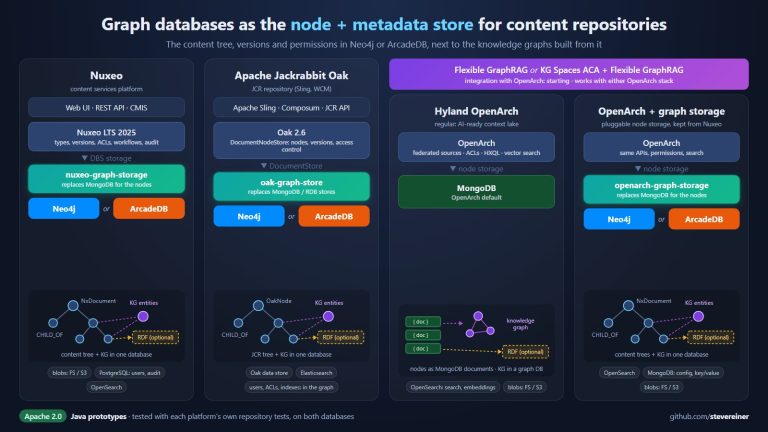
Now available: three Apache 2.0 Java projects that keep a content repositories’ whole tree (documents, folders, metadata, versions, permissions) in Neo4j or ArcadeDB instead of MongoDB or SQL. The platform and its APIs are unchanged, and every write still goes through the repository.

🔹 nuxeo-graph-storage: Nuxeo LTS 2025 with its document and folder nodes in Neo4j or ArcadeDB. Both run Nuxeo‘s own core repository tests, and the Nuxeo Web UI works with either. https://github.com/stevereiner/nuxeo-graph-storage

🔹 oak-graph-store: Apache Jackrabbit Oak DocumentStores for Neo4j and ArcadeDB, replacing the MongoDB and RDB stores. Apache Sling and Composum Tools run with the whole repository in the graph.
oak-graph-store: https://github.com/stevereiner/oak-graph-store

🔹 openarch-graph-storage: Hyland OpenArch federates AI-ready data from sources across the organization and makes it available to AI services and agents while respecting permissions. OpenArch kept Nuxeo‘s pluggable node storage, so this stores its nodes in Neo4j or ArcadeDB.
openarch-graph-storage: https://github.com/stevereiner/openarch-graph-storage
Hyland OpenArch: https://github.com/Hyland/OpenArch

Why a graph?
• Better modeling: business entities (products, contracts, suppliers) and their relations as typed nodes and edges, not only files.
• Impact and dependency questions, many hops deep, become direct traversals.
• Context graph support: the content tree and the knowledge graphs built from it in one database, entities linked to their source documents.
• AI agents get context and provenance from the graph; the repository still enforces what they may see and do.

What's next
Starting: Flexible GraphRAG and KG Spaces ACA with OpenArch, regular or with openarch-graph-storage. Either way, Flexible GraphRAG can build the knowledge graph in a property graph database (any of 15), an RDF store (any of 4), or both; with graph storage, most likely the same Neo4j or ArcadeDB as the content, plus optional RDF. Flexible GraphRAG‘s Turtle Ontologies work with both property graphs and RDF stores.
Flexible GraphRAG: https://github.com/stevereiner/flexible-graphrag
KG Spaces ACA: https://github.com/stevereiner/kg-spaces-aca

All three node storage projects are prototypes. Feedback welcome.
Flexible GraphRAG now also supports embedded ArcadeDB in addition to remote ArcadeDB

Flexible GraphRAG on GitHub

X.com Steve Reiner @stevereiner  LinkedIn Steve Reiner LinkedIn Posts

Repost of my LinkedIn post from March 10, 2026 (original LinkedIn post)

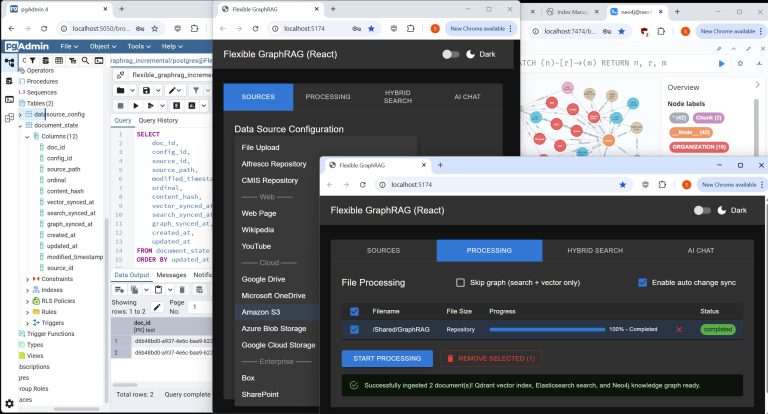
Flexible GraphRAG now also supports ArcadeDB embedded in addition remote ArcadeDB. Both work with the optional incremental update auto sync from data sources. All supported databases (10 vector, 3 search, and 8 graph databases) now work with auto sync. Github https://github.com/stevereiner/flexible-graphrag. With a full hybrid setup (vector, search, graph) all get auto synced.
Finally have pypi built releases (0.4.0) of flexible-graphrag https://pypi.org/project/flexible-graphrag/ and flexible-graphrag-mcp https://pypi.org/project/flexible-graphrag-mcp/

Flexible GraphRAG or RAG is flexing to the max: 8 Graph databases, 10 Vector databases, 3 search engines working (can docker compose all including dashboards), 13 data sources

Flexible GraphRAG on GitHub

X.com Steve Reiner @stevereiner  LinkedIn Steve Reiner LinkedIn Posts

Flexible GraphRAG or Flexible RAG, an Apache 2.0 open source python platform, is now flexing to the max using LlamaIndex, in terms of supporting more databases and data sources: supports 8 graph databases, 10 vector databases, 3 search engines, and 13 data sources,. Also supports knowledge graph auto-building, schemas, LlamaIndex LLMs, Docling doc processing (LlamaParse coming soon), GraphRAG mode, RAG only mode, Hybrid search, and AI query / chat. Has React, Vue, and Angular frontends, and a FastAPI backend. React, Vue, Angular, Backend now work on Windows, Mac, Linux (standalone or in docker). Also has a FastMCP MCP server. Has a convenient docker compose that can include any of the databases (Vector, Graph, Search, Alfresco) and Dashboards / Consoles.

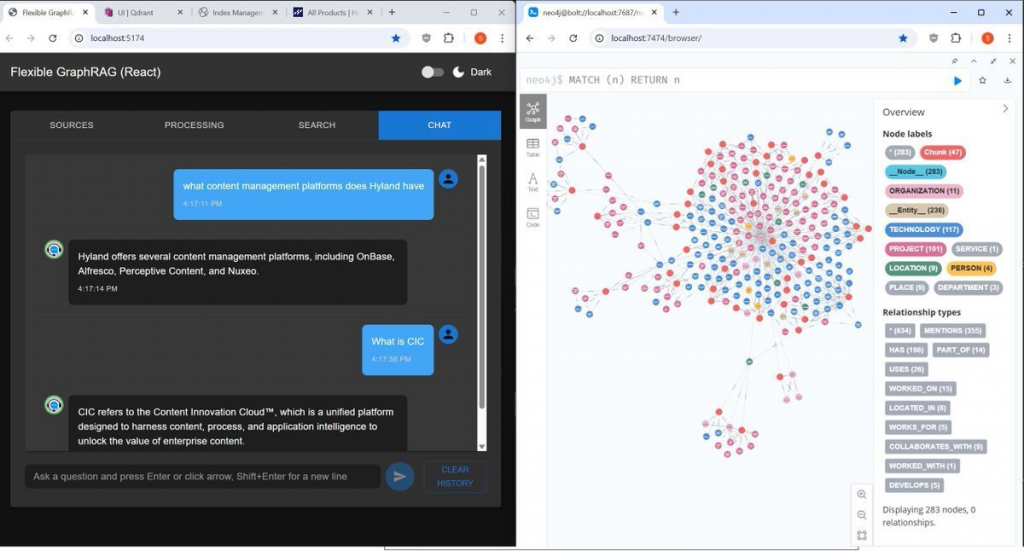
(Flexible GraphRAG AI chat shown with Hyland products web page(s) used with web pages data source to auto-generated a Neo4j graph).

Convenient docker compose: you can choose to include from all supported 10 vector and 8 graph databases, Elasticsearch, OpenSearch, and Hyland Alfresco Community. Include in the docker-compose.yaml by just removing the # comment in front of their includes. Dashboards / Consoles for these databases, as much as possible are also included in the docker compose choices (either in the yaml file for the database or for some a separate yaml file include).

You can run the docker with the databases with the backend and frontends (React, Angular, Vue) running stand alone in separate terminal windows. In addition to running the databases in docker, you can include the backend and frontends in the dock compose by including the app-stack.yaml and proxy.yaml includes. Now have no config duplication for standalone backend+frontends vs full docker mode: previously had to repeat all config in app-stack.yaml now use env_file: include standalone backend .env and overrides with include of docker.env (for configs that need host.docker.internal)

All 8 Graph database working: Neo4j, ArcadeDB, FalkorDB, archived Kuzu (LadybugDB fork todo), NebulaGraph, Memgraph, Amazon Neptune, Amazon Neptune Analytics

All 10 Vector databases working: Qdrant, Elasticsearch vector, OpenSearch vector, Neo4j vector, Milvus, Weaviate, Chroma (both http, embedded), Pinecone, PostgreSQL + pgvector, LanceDB

All 3 Search engines working: Elasticsearch, OpenSearch, LlamaIndex built-in BM25

New Data Sources: using LlamaIndex readers: 1. working ones that don’t use document processing: Web Pages, Wikipedia, Youtube, 2. working using document processing: S3, 3. ones using document processing still to test: Google Drive, Microsoft OneDrive, Azure Blob, GCS, Box, SharePoint.

Support for Docling document processing is currently available. Being able configure to use LlamaParse coming soon.

Original data sources with document processing that don’t use LlamaIndex readers: filesystem, Alfresco, CMIS. Hyland Alfresco Community can be included in the docker compose by taking the “#” comment off the beginning of its include.

LLMs: LlamaIndex LLMs (LlamaIndex has support for very many), Flexible GraphRAG currently has config for 1. tested, working: OpenAI, Ollama, 2. untested: Anthropic Claude, Google Gemini, Azure OpenAI.

Previous Flexible GraphRAG posts:

See Flexible GraphRAG Initial Version Blog Post

See New Tabbed UI for Flexible GraphRAG (and Flexible RAG)

See Flexible GraphRAG: Performance improvements, FalkorDB graph database support added

See Flexible GraphRAG: Supports ArcadeDB Graph Database with new LlamaIndex Integration

See Flexible GraphRAG: Amazon Neptune, Neptune Analytics, and Graph Explorer support added

Flexible GraphRAG: Supports ArcadeDB Graph Database with new LlamaIndex Integration

Flexible GraphRAG on GitHub

X.com Steve Reiner @stevereiner  LinkedIn Steve Reiner LinkedIn Posts

Flexible GraphRAG added support for the ArcadeDB graph database using this new integration:

ArcadeDB LlamaIndex Integration and arcadedb-python available:

arcadedb-llama-index Github

arcadedb-python Github

ArcadeDB (Apache 2.0) is a next generation Multi-Model Database for Graphs, Documents, Key/Value and Time-Series. Supports SQL, Cypher, Gremlin and MongoDB queries

arcadedb.com

ArcadeDB Github

Flexible GraphRAG is open source python platform supporting Docling document processing, knowledge graph auto-building, schemas, 13 data sources, 10 Vector databases, 7 Graph databases, ElasticSearch and OpenSearch search engines, RAG, GraphRAG, hybrid search, and AI query / chat. Has React, Vue, and Angular frontends, and a FastAPI backend. Also has a FastMCP MCP server.

Previous Flexible GraphRAG posts:

See Flexible GraphRAG Initial Version Blog Post

See New Tabbed UI for Flexible GraphRAG (and Flexible RAG)

See Flexible GraphRAG: Performance improvements, FalkorDB graph database support added