YouTube video of KG Spaces for Alfresco (ACA) and KG Spaces for Nuxeo, both based on Flexible GraphRAG v0.9.0, which now supports Hyland OpenArch (all are Apache 2.0 open source). KG Spaces Deployment uses docker compose to deploy the whole stack (KG Spaces apps, Flexible GraphRAG, OpenArch and Alfresco and/or Nuxeo) Recorded in HD: to read the UI, set the YouTube player’s quality to 1024p HD with the ⚙ Settings → Quality menu. https://youtu.be/1DV1_QwGz74
Flexible GraphRAG v0.9.0 and KG Spaces v0.9.0 are released, with support for Hyland OpenArch.
Hyland OpenArch federates unstructured, AI-ready data from all sources across an organization and makes it available to AI services and agents while always respecting permissions. GitHub: https://github.com/Hyland/OpenArch
In OpenArch mode, OpenArch is the search, vector, and document state store. Flexible GraphRAG sends it parsed text from its doc processors (Docling, LlamaParse, LiteParse) plus embedding chunks, and keeps building knowledge graphs into any of 15 property graph databases and/or 4 RDF stores. Search and AI query fuse graph and RDF results with OpenArch search and vector results.
All 14 data sources work with OpenArch, 10 with incremental auto-sync: Auto-sync: Alfresco, Nuxeo, SharePoint, OneDrive, Box, Google Drive, Amazon S3, Google Cloud Storage, Azure Blob Storage, Filesystem Without: CMIS, Web Pages, Wikipedia, YouTube
Builds on the 0.8.x permission work: per-source sign-in/sign-out, results filtered to what each user can see (UI and MCP), and filter pills to pick which sources feed hybrid search and AI chat. v0.9.0 adds separate Graph and RDF columns to the Processing table for per-file/folder options.
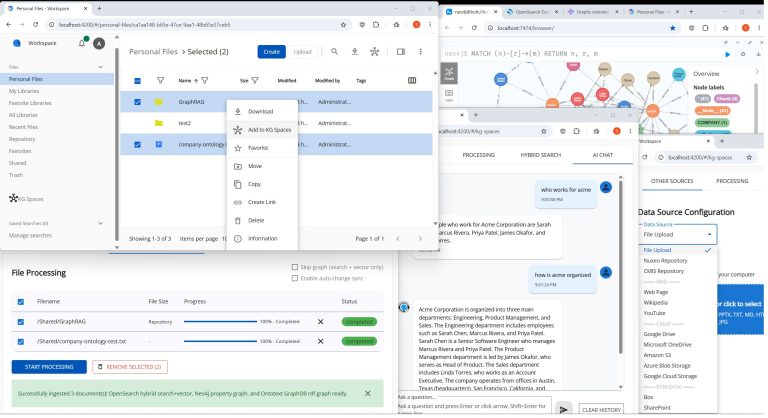
🔹 KG Spaces for Alfresco ACA: “Add to KG Spaces” (ingest, or manage search+vector, graph, RDF, auto-sync) and “Ask KG Spaces about this folder or document” GitHub: https://github.com/stevereiner/kg-spaces-aca
🔹 KG Spaces Deployment: one Docker Compose with Alfresco, Nuxeo, Hyland OpenArch, Flexible GraphRAG and both KG Spaces UIs; pick your graph DB and/or RDF store GitHub: https://github.com/stevereiner/kg-spaces-deployment
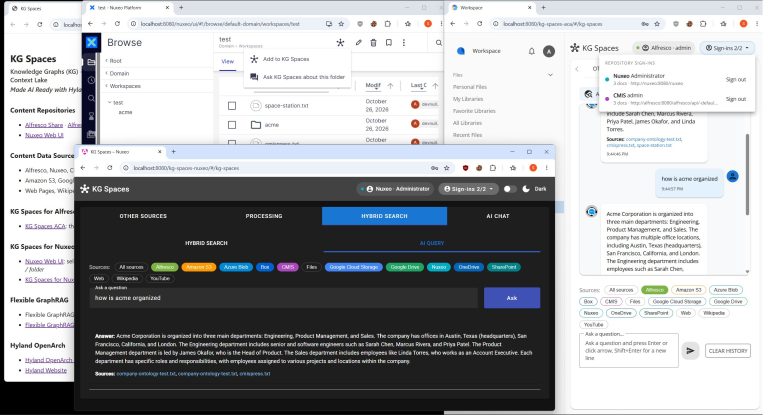
📸 The image: KG Spaces landing page, Nuxeo Web UI with Add to KG Spaces, KG Spaces for Nuxeo AI query, and KG Spaces for ACA AI chat, with search filter pills from ingesting all 14 sources.
Knowledge graphs auto-generated from your documents, alongside vector and fulltext indexes, provide the context for hybrid search, AI query and AI chat. It works over Alfresco content and other data sources, right inside ACA.
AI context DBs (choose 0 or 1 of each kind): 15 Property Graph (including Neo4j, ArcadeDB, FalkorDB, LadybugDB), 4 RDF, 10 Vector, and OpenSearch or Elasticsearch. Data sources: use any of 14 together, 10 with auto sync.
Highlights: • Built as a separate ACA extension under the Apache 2.0 license • Multi-select any mix of Alfresco files and folders from ACA’s regular file list views • New data sources tab (labeled “Other Sources”) for choosing any other data source Flexible GraphRAG supports • AI context can stay up to date through auto change sync from Alfresco, Nuxeo, SharePoint, Box, Amazon S3, Azure Blob Storage, Google Cloud Storage, Google Drive and OneDrive. File Upload, CMIS, Web Pages, Wikipedia and YouTube can be ingested without auto sync. • Shares the Flexible GraphRAG Angular UI through a public npm package • Can build a Docker image with ACA + kg-spaces-aca
The backend is Flexible GraphRAG v0.8.2+ (flexible-graphrag GitHub: https://github.com/stevereiner/flexible-graphrag), an open source AI context platform. It includes: • Document processing with Docling, LlamaParse or LiteParse • Knowledge graph auto-building, ontologies and schemas • Many LLM providers • GraphRAG and RAG • Hybrid search (fulltext, vector, property graph, RDF/SPARQL) • AI query and AI chat
Coming next: optional support for Hyland OpenArch (Hyland Open AI Ready Content Hub) in both kg-spaces-aca and the Flexible GraphRAG backend.
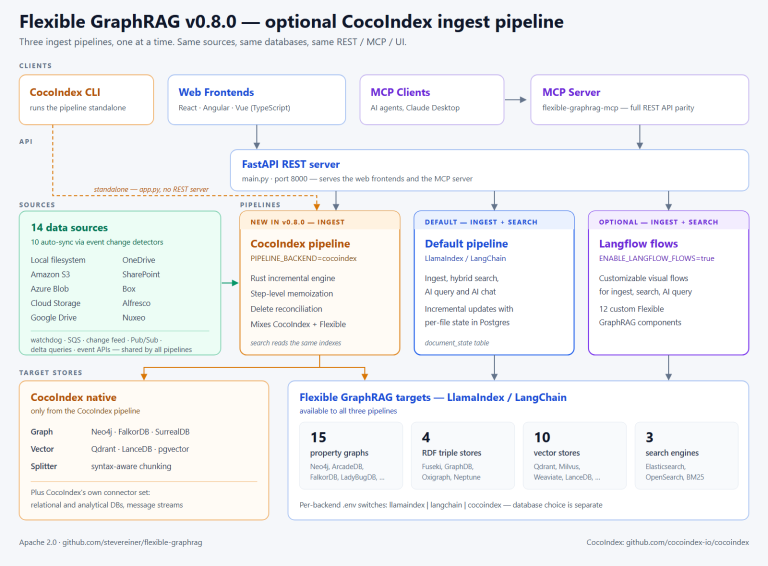
Flexible GraphRAG v0.8.0 released, with an optional CocoIndex integration. CocoIndex is a Rust based incremental sync and processing engine for context, agents, and data pipelines. You can now use a CocoIndex pipeline working inside the Flexible GraphRAG app instead of the default pipeline.
Mixing components: CocoIndex components (source/target connectors, functions, splitting) and Flexible GraphRAG “Flexible” components: data sources, LlamaIndex / LangChain targets, document processing (LiteParse, Docling, LlamaParse), splitting, chunking, ontologies, KG extraction. These are separate from the Langflow “Flexible” components. In .env you pick a backend per piece (source, chunker, property graph, vector, search, KG extractor): llamaindex, langchain, or cocoindex; the database is configured separately. RDF is LangChain only, and KG extraction is LlamaIndex / LangChain, although the new custom KG extractors can use CocoIndex’s entity resolver.
Incremental updates: CocoIndex deals with incremental handling — step-level memoization, automatic delete reconciliation — instead of the Python based incremental update system. Postgres still keeps track of the data sources configured in the UI (datasource_config table), but the document_state table is not used. The event change detectors from the default system are also used with the CocoIndex pipeline for “Flexible” data sources: Alfresco ActiveMQ, Nuxeo Kafka, S3 SQS, Azure Blob change feed, GCS Pub/Sub, Google Drive Changes API, OneDrive/SharePoint MS Graph delta query, Box Events API, and Local Filesystem watchdog.
Outside the app too: this CocoIndex pipeline “app file” can be used outside the Flexible GraphRAG app for custom mixed apps. Also, CocoIndex provides CLI support.
Flexible GraphRAG components can be used : 14 data sources (10 auto syncing) and all the DBs — 15 property graphs, 4 RDF stores, 10 vector stores, 3 search engines. CocoIndex native components can be used too: vector DBs, property graph DBs, relational and analytical DBs, and message streams: https://cocoindex.io/docs/connectors/
A Flexible GraphRAG CocoIndex Integration Meeting Notes Knowledge Graph example is provided: any of 10 data sources, to any of 15 property graph databases.
Flexible GraphRAG is an Apache 2.0 open source AI context platform: document processing, knowledge graph auto-building, ontologies, many LLM providers, GraphRAG and RAG, hybrid semantic search, AI query, and AI chat. Python backend (LlamaIndex + LangChain), Angular / React / Vue frontends, an MCP server, Hyland Alfresco , Hyland Nuxeo support, and Docker Compose any database, dashboard.
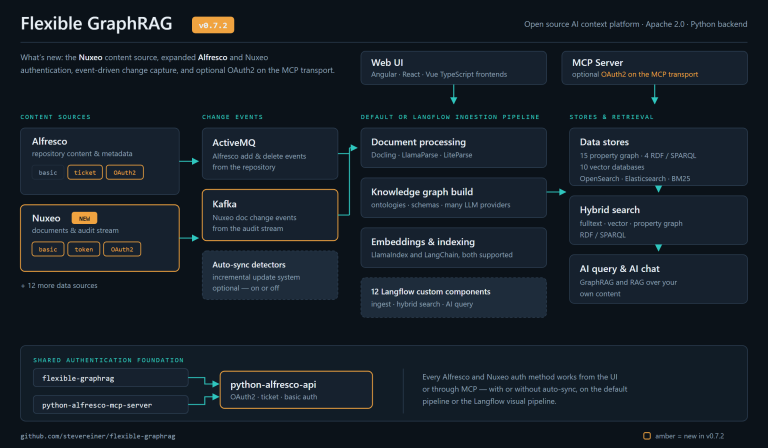
Flexible GraphRAG v0.7.2 is out 🚀 🆕 Hyland Nuxeo is now a supported data source, with OAuth2, token, and basic authentication. 🔐 Hyland Alfresco data source gains OAuth2 and ticket authentication in addition to basic authentication. 🔑 The Flexible GraphRAG MCP Server optionally supports OAuth2 on the MCP transport itself.
📡 ActiveMQ carries Alfresco add, delete, and modify events, and Kafka carries Nuxeo document change events off the audit stream.
Alfresco and Nuxeo authentication works from the UI or through MCP, with or without the auto-sync incremental update system enabled, and on either the default pipeline or the Langflow visual ingest pipeline.
The python-alfresco-mcp-server was also updated, adding OAuth2 and ticket auth plus optional MCP transport OAuth2. Both projects build on the updated python-alfresco-api, which provides the enhanced OAuth2, ticket, and basic authentication.
Flexible GraphRAG is an Apache 2.0 open source AI context platform: a document processing pipeline (Docling, LlamaParse, or LiteParse), knowledge graph auto-building, ontologies and schemas, many LLM providers, GraphRAG and RAG, hybrid semantic search (fulltext, vector, property graph, RDF/SPARQL), AI query, and AI chat.
The backend is Python, with both LlamaIndex and LangChain fully supported. Angular, React, and Vue TypeScript frontends and an MCP server are included.
The stack supports 14 data sources (10 with incremental auto-sync), 15 property graph databases, 4 RDF triple stores, 10 vector databases, and OpenSearch / Elasticsearch / BM25 search, plus Alfresco and Nuxeo. All databases and dashboards can be enabled with the provided Docker Compose layout.
Optionally, the ingest pipeline, hybrid search, and AI query can run through customizable Langflow visual flows (12 custom components).