X.com Steve Reiner @stevereiner LinkedIn Steve Reiner LinkedIn Posts
Repost of my LinkedIn post from October 16, 2026 (original LinkedIn post)
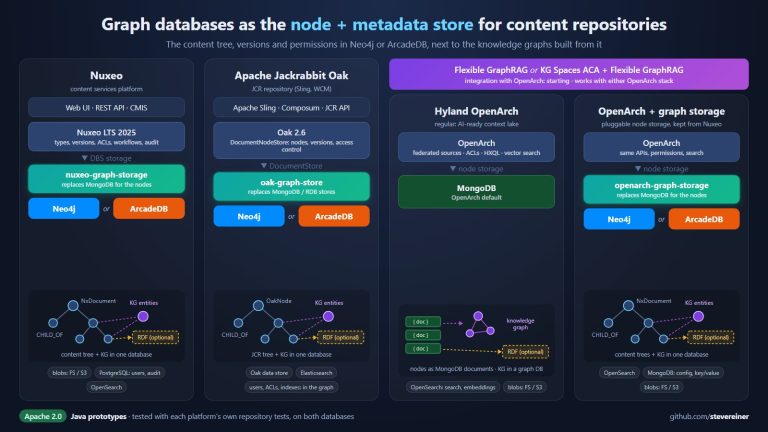
Graph databases as the node store for content repositories: three new open source projects:
Now available: three Apache 2.0 Java projects that keep a content repositories’ whole tree (documents, folders, metadata, versions, permissions) in Neo4j or ArcadeDB instead of MongoDB or SQL. The platform and its APIs are unchanged, and every write still goes through the repository.
🔹 nuxeo-graph-storage: Nuxeo LTS 2025 with its document and folder nodes in Neo4j or ArcadeDB. Both run Nuxeo‘s own core repository tests, and the Nuxeo Web UI works with either. https://github.com/stevereiner/nuxeo-graph-storage
🔹 oak-graph-store: Apache Jackrabbit Oak DocumentStores for Neo4j and ArcadeDB, replacing the MongoDB and RDB stores. Apache Sling and Composum Tools run with the whole repository in the graph.
oak-graph-store: https://github.com/stevereiner/oak-graph-store
🔹 openarch-graph-storage: Hyland OpenArch federates AI-ready data from sources across the organization and makes it available to AI services and agents while respecting permissions. OpenArch kept Nuxeo‘s pluggable node storage, so this stores its nodes in Neo4j or ArcadeDB.
openarch-graph-storage: https://github.com/stevereiner/openarch-graph-storage
Hyland OpenArch: https://github.com/Hyland/OpenArch
Why a graph?
• Better modeling: business entities (products, contracts, suppliers) and their relations as typed nodes and edges, not only files.
• Impact and dependency questions, many hops deep, become direct traversals.
• Context graph support: the content tree and the knowledge graphs built from it in one database, entities linked to their source documents.
• AI agents get context and provenance from the graph; the repository still enforces what they may see and do.
What's next
Starting: Flexible GraphRAG and KG Spaces ACA with OpenArch, regular or with openarch-graph-storage. Either way, Flexible GraphRAG can build the knowledge graph in a property graph database (any of 15), an RDF store (any of 4), or both; with graph storage, most likely the same Neo4j or ArcadeDB as the content, plus optional RDF. Flexible GraphRAG‘s Turtle Ontologies work with both property graphs and RDF stores.
Flexible GraphRAG: https://github.com/stevereiner/flexible-graphrag
KG Spaces ACA: https://github.com/stevereiner/kg-spaces-aca
All three node storage projects are prototypes. Feedback welcome.