Graph databases as the node store for content repositories: three new open source projects

Flexible GraphRAG on GitHub

X.com Steve Reiner @stevereiner  LinkedIn Steve Reiner LinkedIn Posts

Repost of my LinkedIn post from October 16, 2026 (original LinkedIn post)
Graph databases as the node store for content repositories: three new open source projects:
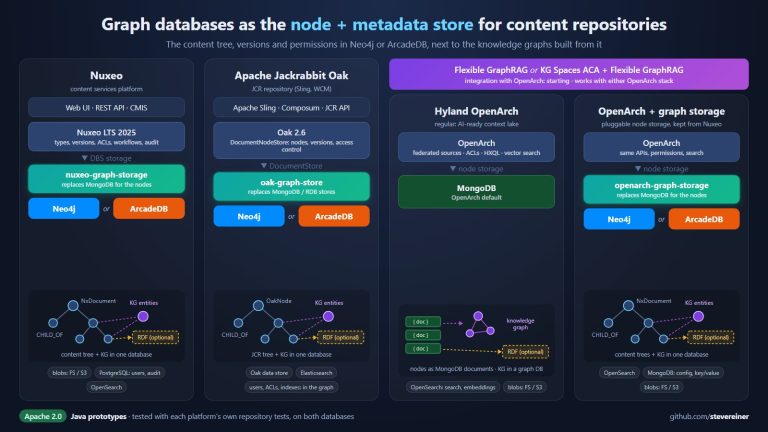
Now available: three Apache 2.0 Java projects that keep a content repositories’ whole tree (documents, folders, metadata, versions, permissions) in Neo4j or ArcadeDB instead of MongoDB or SQL. The platform and its APIs are unchanged, and every write still goes through the repository.

🔹 nuxeo-graph-storage: Nuxeo LTS 2025 with its document and folder nodes in Neo4j or ArcadeDB. Both run Nuxeo‘s own core repository tests, and the Nuxeo Web UI works with either. https://github.com/stevereiner/nuxeo-graph-storage

🔹 oak-graph-store: Apache Jackrabbit Oak DocumentStores for Neo4j and ArcadeDB, replacing the MongoDB and RDB stores. Apache Sling and Composum Tools run with the whole repository in the graph.
oak-graph-store: https://github.com/stevereiner/oak-graph-store

🔹 openarch-graph-storage: Hyland OpenArch federates AI-ready data from sources across the organization and makes it available to AI services and agents while respecting permissions. OpenArch kept Nuxeo‘s pluggable node storage, so this stores its nodes in Neo4j or ArcadeDB.
openarch-graph-storage: https://github.com/stevereiner/openarch-graph-storage
Hyland OpenArch: https://github.com/Hyland/OpenArch

Why a graph?
• Better modeling: business entities (products, contracts, suppliers) and their relations as typed nodes and edges, not only files.
• Impact and dependency questions, many hops deep, become direct traversals.
• Context graph support: the content tree and the knowledge graphs built from it in one database, entities linked to their source documents.
• AI agents get context and provenance from the graph; the repository still enforces what they may see and do.

What's next
Starting: Flexible GraphRAG and KG Spaces ACA with OpenArch, regular or with openarch-graph-storage. Either way, Flexible GraphRAG can build the knowledge graph in a property graph database (any of 15), an RDF store (any of 4), or both; with graph storage, most likely the same Neo4j or ArcadeDB as the content, plus optional RDF. Flexible GraphRAG‘s Turtle Ontologies work with both property graphs and RDF stores.
Flexible GraphRAG: https://github.com/stevereiner/flexible-graphrag
KG Spaces ACA: https://github.com/stevereiner/kg-spaces-aca

All three node storage projects are prototypes. Feedback welcome.
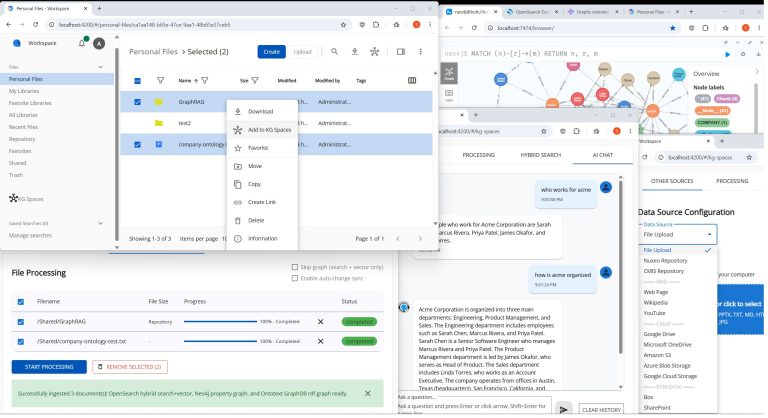
A redone KG Spaces (Flexible GraphRAG) for the Alfresco Content App (ACA) 8.0.0 is now available

Flexible GraphRAG on GitHub

X.com Steve Reiner @stevereiner  LinkedIn Steve Reiner LinkedIn Posts

Repost of my LinkedIn post from October 3, 2026 (original LinkedIn post)

A redone KG Spaces (Flexible GraphRAG) for the Alfresco Content App (ACA) 8.0.0 is now available.
kg-spaces-aca Github: https://github.com/stevereiner/kg-spaces-aca

Knowledge graphs auto-generated from your documents, alongside vector and fulltext indexes, provide the context for hybrid search, AI query and AI chat. It works over Alfresco content and other data sources, right inside ACA.

AI context DBs (choose 0 or 1 of each kind): 15 Property Graph (including Neo4j, ArcadeDB, FalkorDB, LadybugDB), 4 RDF, 10 Vector, and OpenSearch or Elasticsearch. Data sources: use any of 14 together, 10 with auto sync.

Highlights:
• Built as a separate ACA extension under the Apache 2.0 license
• Multi-select any mix of Alfresco files and folders from ACA’s regular file list views
• New data sources tab (labeled “Other Sources”) for choosing any other data source Flexible GraphRAG supports
• AI context can stay up to date through auto change sync from Alfresco, Nuxeo, SharePoint, Box, Amazon S3, Azure Blob Storage, Google Cloud Storage, Google Drive and OneDrive. File Upload, CMIS, Web Pages, Wikipedia and YouTube can be ingested without auto sync.
• Shares the Flexible GraphRAG Angular UI through a public npm package
• Can build a Docker image with ACA + kg-spaces-aca

The backend is Flexible GraphRAG v0.8.2+ (flexible-graphrag GitHub: https://github.com/stevereiner/flexible-graphrag), an open source AI context platform. It includes:
• Document processing with Docling, LlamaParse or LiteParse
• Knowledge graph auto-building, ontologies and schemas
• Many LLM providers
• GraphRAG and RAG
• Hybrid search (fulltext, vector, property graph, RDF/SPARQL)
• AI query and AI chat

Coming next: optional support for Hyland OpenArch (Hyland Open AI Ready Content Hub) in both kg-spaces-aca and the Flexible GraphRAG backend.

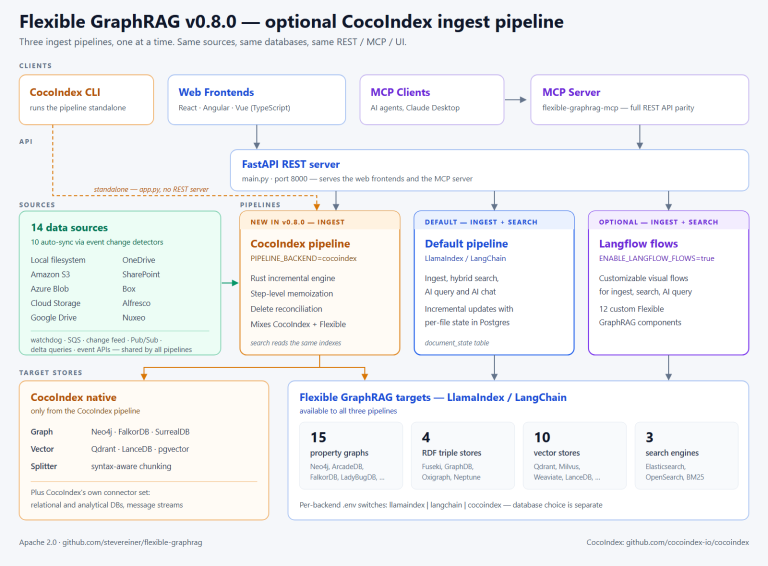
Flexible GraphRAG v0.8.0 released, with an optional CocoIndex integration

Flexible GraphRAG on GitHub

X.com Steve Reiner @stevereiner  LinkedIn Steve Reiner LinkedIn Posts

Repost of my LinkedIn post from August 20, 2026 (original LinkedIn post)

Flexible GraphRAG v0.8.0 released, with an optional CocoIndex integration. CocoIndex is a Rust based incremental sync and processing engine for context, agents, and data pipelines.
You can now use a CocoIndex pipeline working inside the Flexible GraphRAG app instead of the default pipeline.

Mixing components: CocoIndex components (source/target connectors, functions, splitting) and Flexible GraphRAG “Flexible” components: data sources, LlamaIndex / LangChain targets, document processing (LiteParse, Docling, LlamaParse), splitting, chunking, ontologies, KG extraction. These are separate from the Langflow “Flexible” components. In .env you pick a backend per piece (source, chunker, property graph, vector, search, KG extractor): llamaindex, langchain, or cocoindex; the database is configured separately. RDF is LangChain only, and KG extraction is LlamaIndex / LangChain, although the new custom KG extractors can use CocoIndex’s entity resolver.

Incremental updates: CocoIndex deals with incremental handling — step-level memoization, automatic delete reconciliation — instead of the Python based incremental update system. Postgres still keeps track of the data sources configured in the UI (datasource_config table), but the document_state table is not used. The event change detectors from the default system are also used with the CocoIndex pipeline for “Flexible” data sources: Alfresco ActiveMQ, Nuxeo Kafka, S3 SQS, Azure Blob change feed, GCS Pub/Sub, Google Drive Changes API, OneDrive/SharePoint MS Graph delta query, Box Events API, and Local Filesystem watchdog.

Outside the app too: this CocoIndex pipeline “app file” can be used outside the Flexible GraphRAG app for custom mixed apps. Also, CocoIndex provides CLI support.

Flexible GraphRAG components can be used : 14 data sources (10 auto syncing) and all the DBs — 15 property graphs, 4 RDF stores, 10 vector stores, 3 search engines. CocoIndex native components can be used too: vector DBs, property graph DBs, relational and analytical DBs, and message streams: https://cocoindex.io/docs/connectors/

A Flexible GraphRAG CocoIndex Integration Meeting Notes Knowledge Graph example is provided: any of 10 data sources, to any of 15 property graph databases.

Flexible GraphRAG is an Apache 2.0 open source AI context platform: document processing, knowledge graph auto-building, ontologies, many LLM providers, GraphRAG and RAG, hybrid semantic search, AI query, and AI chat. Python backend (LlamaIndex + LangChain), Angular / React / Vue frontends, an MCP server, Hyland Alfresco , Hyland Nuxeo support, and Docker Compose any database, dashboard.

GitHub: https://github.com/stevereiner/flexible-graphrag
Docs: https://stevereiner.github.io/flexible-graphrag/
PyPI: https://pypi.org/project/flexible-graphrag/
MCP PyPI: https://pypi.org/project/flexible-graphrag-mcp/
Docker: https://hub.docker.com/u/integratedsemantics
Blog: https://integratedsemantics.org/
CocoIndex: https://github.com/cocoindex-io/cocoindex

Flexible GraphRAG v0.7.2 is out: Hyland Nuxeo data source, OAuth2 and ticket auth for Alfresco, OAuth2 for the MCP server

Flexible GraphRAG on GitHub

X.com Steve Reiner @stevereiner  LinkedIn Steve Reiner LinkedIn Posts

Repost of my LinkedIn post from August 10, 2026 (original LinkedIn post)

Flexible GraphRAG v0.7.2 is out 🚀
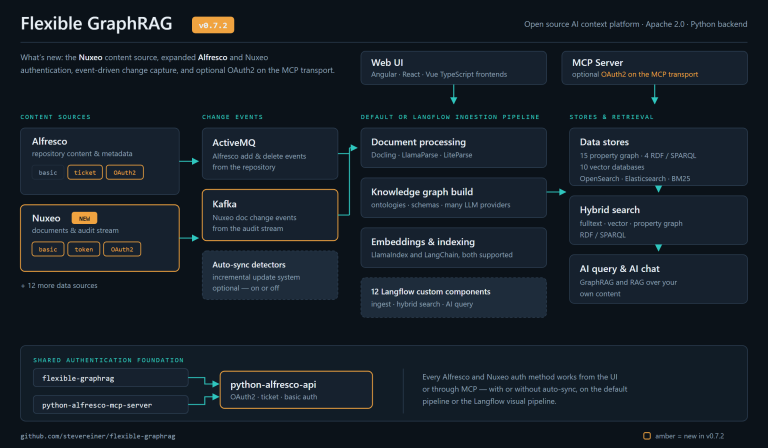
🆕 Hyland Nuxeo is now a supported data source, with OAuth2, token, and basic authentication.
🔐 Hyland Alfresco data source gains OAuth2 and ticket authentication in addition to basic authentication.
🔑 The Flexible GraphRAG MCP Server optionally supports OAuth2 on the MCP transport itself.

📡 ActiveMQ carries Alfresco add, delete, and modify events, and Kafka carries Nuxeo document change events off the audit stream.

Alfresco and Nuxeo authentication works from the UI or through MCP, with or without the auto-sync incremental update system enabled, and on either the default pipeline or the Langflow visual ingest pipeline.

The python-alfresco-mcp-server was also updated, adding OAuth2 and ticket auth plus optional MCP transport OAuth2. Both projects build on the updated python-alfresco-api, which provides the enhanced OAuth2, ticket, and basic authentication.

Flexible GraphRAG is an Apache 2.0 open source AI context platform: a document processing pipeline (Docling, LlamaParse, or LiteParse), knowledge graph auto-building, ontologies and schemas, many LLM providers, GraphRAG and RAG, hybrid semantic search (fulltext, vector, property graph, RDF/SPARQL), AI query, and AI chat.

The backend is Python, with both LlamaIndex and LangChain fully supported. Angular, React, and Vue TypeScript frontends and an MCP server are included.

The stack supports 14 data sources (10 with incremental auto-sync), 15 property graph databases, 4 RDF triple stores, 10 vector databases, and OpenSearch / Elasticsearch / BM25 search, plus Alfresco and Nuxeo. All databases and dashboards can be enabled with the provided Docker Compose layout.

Optionally, the ingest pipeline, hybrid search, and AI query can run through customizable Langflow visual flows (12 custom components).

flexible-graphrag github: https://github.com/stevereiner/flexible-graphrag

python-alfresco-mcp-server github: https://github.com/stevereiner/python-alfresco-mcp-server

python-alfresco-api github: https://github.com/stevereiner/python-alfresco-api

Flexible GraphRAG v0.7.1 is out: Visual Langflow integration, LiteParse support, and Microsoft Graph delta query (SharePoint, OneDrive)

Flexible GraphRAG on GitHub

X.com Steve Reiner @stevereiner  LinkedIn Steve Reiner LinkedIn Posts

Repost of my LinkedIn post from July 23, 2026 (original LinkedIn post)

Flexible GraphRAG v0.7.1 is out: Visual Langflow integration, LiteParse support, and Msft Graph delta query (SharePoint, OneDrive). v0.8.0, with optional CocoIndex support, is coming soon. Details in article:

Details

From my LinkedIn article (original article)

Flexible GraphRAG v0.7.1 released : Visual Langflow integration, added LiteParse support, and Microsoft Graph delta query (efficient incremental update for SharePoint, OneDrive). Also for v0.8.0, have optional initial support for CocoIndex coming soon.

Github: https://github.com/stevereiner/flexible-graphrag

1. Optional visual Langflow flows to customize the ingest pipeline and search flows used “under the covers” of the UI (OpenRAG like). Also have configurable “Flexible" Langflow components to use in other apps. Langflow+components can be used “standalone” running in a separate venv from the main Flexible GraphRAG backend venv, or with a new docker with the flexible components, available on https://hub.docker.com/u/integratedsemantics (along with the previous optional dockers for backend, react, vue, and angular frontends)

2. A Previous post mentioned that if Langflow mode is enabled, incremental updating will also flow thru the customizable pipeline. Now all 13 data sources will flow thru it and some fixes were made. App UI , MCP, and REST all will use the visual flows when the ENABLE_LANGFLOW_FLOWS is true.

3. Added support for the open source LiteParse from LlamaIndex in addition to previous support for Docling and LlamaParse (LiteParse can be configured to send to other parsers for a list of complexity reasons) LiteParse github https://github.com/run-llama/liteparse

4. Added support for Microsoft delta query for efficient incremental change updating for SharePoint and OneDrive data sources.

5. For v0.8.0 (not checked in) have an optional CocoIndex pipeline working inside the Flexible GraphRAG app. CocoIndex github https://github.com/cocoindex-io/cocoindex This pipeline supports mixing CocoIndex things and "Flexible LlamaIndex / LangChain things” from Flexible GraphRAG. Things = connectors (sources, targets), functions ( document processor supporting Docling, LlamaParse, and Liteparse, chunking / splitting, and KG extraction). These are separate from the Langflow “Flexible” components. With this pipeline, CocoIndex deals with incremental handling instead of the existing Flexible GraphRAG Python based incremental update system with Postgres for state management. Still can use it to keep track of multiple datasource_configs, setup in the app UI, and optional monitoring logging.

6. This CocoIndex pipeline app can be used outside of the Flexible GraphRAG app for custom mixed apps.

7. Thus Flexible GraphRAG things can be used : 13 data sources (9 auto syncing with Alfresco ActiveMQ, S3 SQS, Azure change feed, GCS pub/sub, MS Graph delta query, watchdog filesystem change detectors), DBs: 15 property graphs, 4 RDF stores, 10 vector stores, 3 search engines) in addition to CocoIndex "native" things. In the .env config, for each backend ( source, property graph , search, vector, chunker/spitter) in framework config section, you can setup to use llamaindex, langchain or cocoindex. RDF is langchain only, KG extraction is currently only llamaindex or langchain. What particular database to use is separately configured.

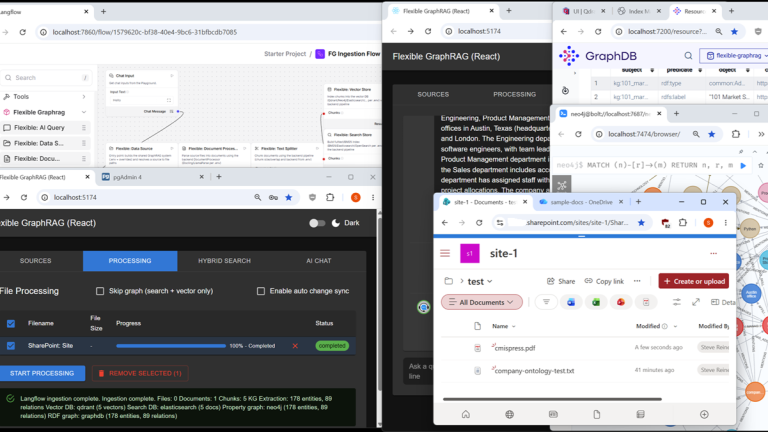
8. Screenshot shows Flexible GraphRAG running in Langflow pipeline mode, with an auto sync data source setup with SharePoint (using MS delta query), PDF file was parsed by LiteParse, with Qdrant vector, Elastic search, Neo4j property graph, and Graphwise Ontotext GraphDB RDF graph all getting initial sync, add, delete, modify changes. Flexible GraphRAG processing tab shows initial sync status, chat is being used to ask “Who works for Acme” and “How is Acme organized” using context in all 4 dbs from the ingestion of company-ontology-test.txt (Flexible GraphRAG was setup in ontology mode with 3 ttl turtle files)