Flexible GraphRAG v0.6.0 released: Full LangChain support in addition to LlamaIndex, 15 graph, 4 RDF, 10 vector, 3 search databases

Flexible GraphRAG on GitHub

X.com Steve Reiner @stevereiner  LinkedIn Steve Reiner LinkedIn Posts

Repost of my LinkedIn post from May 15, 2026 (original LinkedIn post)
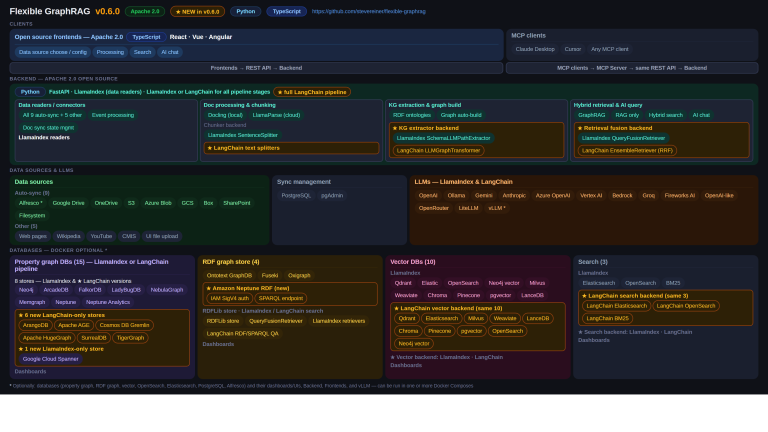
Flexible GraphRAG v0.6.0 released: Full LangChain support in addition to LlamaIndex, more DBs: 15 graph (8 + Arango, Apache AGE, Microsoft Azure Cosmos for Gremlin, SurrealDB, Google Cloud Spanner, HugeGraph, TigerGraph), 4 RDF (3 + Amazon Neptune RDF), 10 vector, 3 search.

GitHub repo: https://github.com/stevereiner/flexible-graphrag

Flexible GraphRAG is an Apache 2.0 open source AI context platform supporting a document processing pipeline (Docling or LlamaParse), knowledge graph auto-building, ontologies, schemas, many LLM providers, GraphRAG and RAG, hybrid semantic search (fulltext, vector, property graph, RDF/SPARQL), AI query, and AI chat. The backend is Python. Angular, React, and Vue TypeScript frontends and an MCP server are included. The stack supports 13 data sources (9 with incremental auto-sync), 15 property graph databases, 4 RDF triple stores , 10 vector databases, OpenSearch / Elasticsearch / BM25 search, and Alfresco.

Goals for added Flexibility with Frameworks and Pipelines:
1. More Databases
2.a. Framework Independence (with adapter layer)
2.b. support both LangChain and LlamaIndex python application / agent developers (will need python apis not just current REST and MCP).
3. Flexible pipelines: custom python for stages and pipelines
4. Support OpenRAG or OpenRAG like with customizable visual Langflow
flows for the pipeline and retrieval flows.
5. Support the CocoIndex rust pipeline and incremental engine as option to current flexible graphrag incremental update system (python/postgres). Also Flexible GraphRAG data sources and property graph, rdf, vector, search dbs could be used with CocoIndex as custom connectors (in addition native and other custom CocoIndex connectors). Flexible GraphRAG’s React, Vue, and Angular frontends would provide UI.

What's new:
• Full LlamaIndex, LangChain or mixed pipeline: chunker, KG extractor, graph/vector/search backends, retrieval fusion — each independently configurable
• 15 property graph DBs (8 LI stores + 8 LangChain matching versions + 6 LC-only + 1 new LI) All 15 can be used in a LlamaIndex or LangChain focused pipeline
• 4 RDF stores — now includes Amazon Neptune RDF
• 10 LangChain vector backends + 3 LangChain search backends duplicate LlamaIndex support
• LangChain EnsembleRetriever (RRF) + text-to Cypher / GQL / SurrealQL / AQL / SPARQL graph QA
• Docling OCR support (RapidOCR, EasyOCR, Tesseract, and more)
• Incremental add/delete/modify across all graph, vector, search, and RDF backends (for both LlamaIndex and LangChain backend stores)
• Integration testing: run_matrix and run_overnight can test all databases, LI / LC pipeline stages, all LLM providers, and all embedding providers

Update, v0.6.1 (May 16, 2026): Updated to v0.6.1 to fix packaging missing adapter files. The issue happened when installing from PyPI, not when using a GitHub source clone. The latest on PyPI is now 0.6.1 for both the main backend: https://pypi.org/project/flexible-graphrag/ and the MCP server: https://pypi.org/project/flexible-graphrag-mcp/
Flexible GraphRAG or RAG is flexing to the max: 8 Graph databases, 10 Vector databases, 3 search engines working (can docker compose all including dashboards), 13 data sources

Flexible GraphRAG on GitHub

X.com Steve Reiner @stevereiner  LinkedIn Steve Reiner LinkedIn Posts

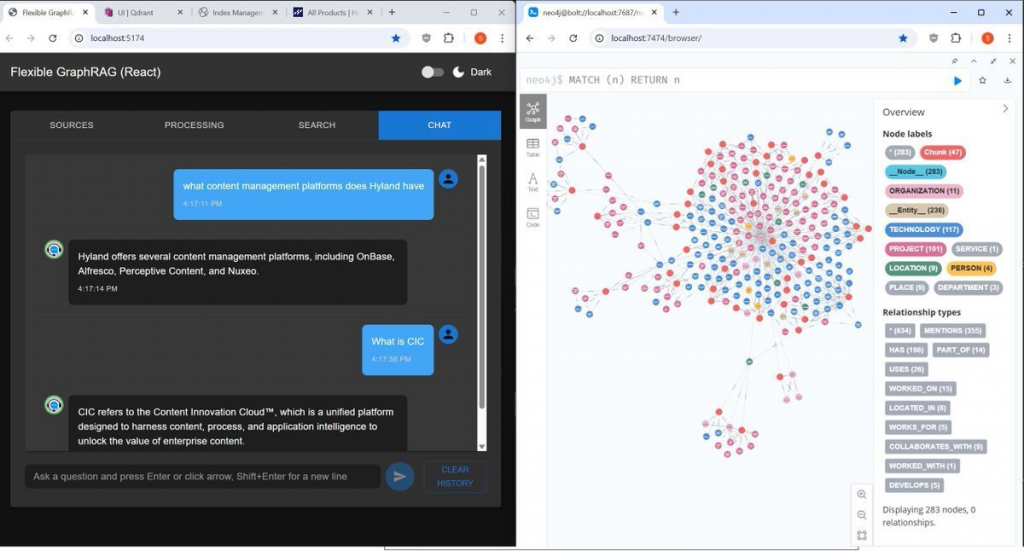
Flexible GraphRAG or Flexible RAG, an Apache 2.0 open source python platform, is now flexing to the max using LlamaIndex, in terms of supporting more databases and data sources: supports 8 graph databases, 10 vector databases, 3 search engines, and 13 data sources,. Also supports knowledge graph auto-building, schemas, LlamaIndex LLMs, Docling doc processing (LlamaParse coming soon), GraphRAG mode, RAG only mode, Hybrid search, and AI query / chat. Has React, Vue, and Angular frontends, and a FastAPI backend. React, Vue, Angular, Backend now work on Windows, Mac, Linux (standalone or in docker). Also has a FastMCP MCP server. Has a convenient docker compose that can include any of the databases (Vector, Graph, Search, Alfresco) and Dashboards / Consoles.

(Flexible GraphRAG AI chat shown with Hyland products web page(s) used with web pages data source to auto-generated a Neo4j graph).

Convenient docker compose: you can choose to include from all supported 10 vector and 8 graph databases, Elasticsearch, OpenSearch, and Hyland Alfresco Community. Include in the docker-compose.yaml by just removing the # comment in front of their includes. Dashboards / Consoles for these databases, as much as possible are also included in the docker compose choices (either in the yaml file for the database or for some a separate yaml file include).

You can run the docker with the databases with the backend and frontends (React, Angular, Vue) running stand alone in separate terminal windows. In addition to running the databases in docker, you can include the backend and frontends in the dock compose by including the app-stack.yaml and proxy.yaml includes. Now have no config duplication for standalone backend+frontends vs full docker mode: previously had to repeat all config in app-stack.yaml now use env_file: include standalone backend .env and overrides with include of docker.env (for configs that need host.docker.internal)

All 8 Graph database working: Neo4j, ArcadeDB, FalkorDB, archived Kuzu (LadybugDB fork todo), NebulaGraph, Memgraph, Amazon Neptune, Amazon Neptune Analytics

All 10 Vector databases working: Qdrant, Elasticsearch vector, OpenSearch vector, Neo4j vector, Milvus, Weaviate, Chroma (both http, embedded), Pinecone, PostgreSQL + pgvector, LanceDB

All 3 Search engines working: Elasticsearch, OpenSearch, LlamaIndex built-in BM25

New Data Sources: using LlamaIndex readers: 1. working ones that don’t use document processing: Web Pages, Wikipedia, Youtube, 2. working using document processing: S3, 3. ones using document processing still to test: Google Drive, Microsoft OneDrive, Azure Blob, GCS, Box, SharePoint.

Support for Docling document processing is currently available. Being able configure to use LlamaParse coming soon.

Original data sources with document processing that don’t use LlamaIndex readers: filesystem, Alfresco, CMIS. Hyland Alfresco Community can be included in the docker compose by taking the “#” comment off the beginning of its include.

LLMs: LlamaIndex LLMs (LlamaIndex has support for very many), Flexible GraphRAG currently has config for 1. tested, working: OpenAI, Ollama, 2. untested: Anthropic Claude, Google Gemini, Azure OpenAI.

Previous Flexible GraphRAG posts:

See Flexible GraphRAG Initial Version Blog Post

See New Tabbed UI for Flexible GraphRAG (and Flexible RAG)

See Flexible GraphRAG: Performance improvements, FalkorDB graph database support added

See Flexible GraphRAG: Supports ArcadeDB Graph Database with new LlamaIndex Integration

See Flexible GraphRAG: Amazon Neptune, Neptune Analytics, and Graph Explorer support added

Flexible GraphRAG: Amazon Neptune, Neptune Analytics, and Graph Explorer support added

Flexible GraphRAG on GitHub

X.com Steve Reiner @stevereiner  LinkedIn Steve Reiner LinkedIn Posts

Amazon Neptune, and Amazon Neptune Analytics support is working and checked int0 the Flexible GraphRAG github.

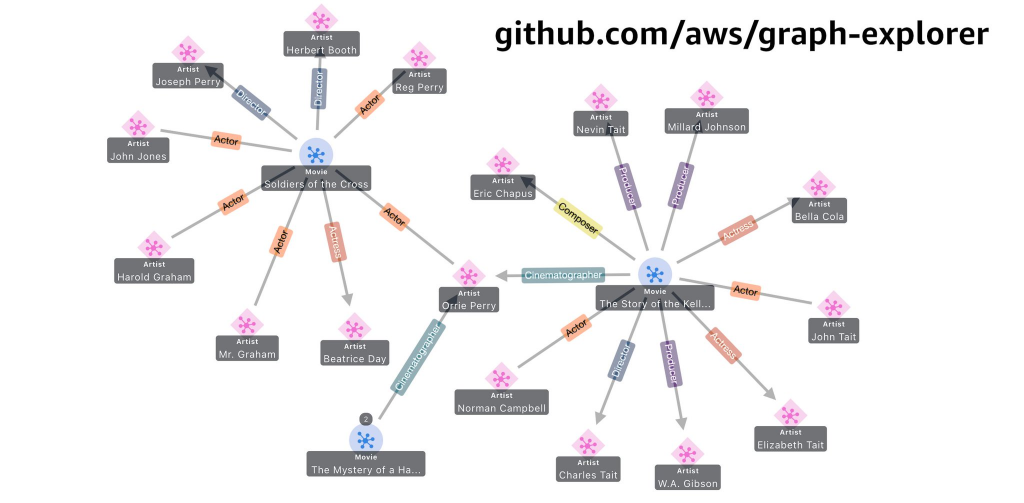
Graph Explorer is supported and working with these graph databases and is also checked in. It runs in a docker and can be used to query and visualize with both Amazon Neptune and Amazon Neptune Analytics.

Gremlin and openCypher can be used in Amazon Neptune with Graph Explorer, while openCypher is the primary language for Neptune Analytics. SPARQL is available for graph queries in the general Neptune database, SPARQL support for Graph Explorer is officially on the AWS development roadmap, but no firm timeline has been announced as of October 2025

Note that for Neptune Analytics, Flexible GraphRAG had to put in a wrapper class to filter out vector queries from its LamaIndex integration that were causing errors in Neptune Analytics. This wasn’t an issue with regular Neptune.

Flexible GraphRAG or Flexible RAG , an Apache 2.0 open source python platform, supports 8 graph databases, 10 vector databases, 3 search engines, and 13 data sources,. Supports knowledge graph auto-building, schemas, LlamaIndex LLMs, Docling doc processing (LlamaParse coming soon), GraphRAG mode, RAG only mode, Hybrid search, and AI query / chat. Has React, Vue, and Angular frontends, and a FastAPI backend. React, Vue, Angular, and Backend now work on Windows, Mac, Linux (standalone or in docker). Has a convenient docker compose that can include any of the databases (vector, graph, search, alfresco) and dashboards / consoles. There is also a Flexible GraphRAG MCP server.

Previous Flexible GraphRAG posts:

See Flexible GraphRAG Initial Version Blog Post

See New Tabbed UI for Flexible GraphRAG (and Flexible RAG)

See Flexible GraphRAG: Performance improvements, FalkorDB graph database support added

See Flexible GraphRAG: Supports ArcadeDB Graph Database with new LlamaIndex Integration