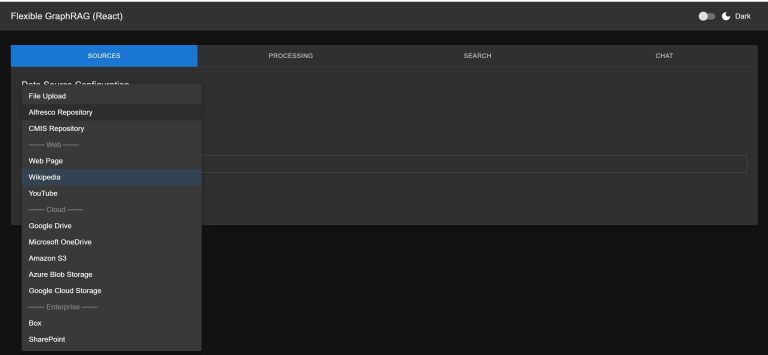
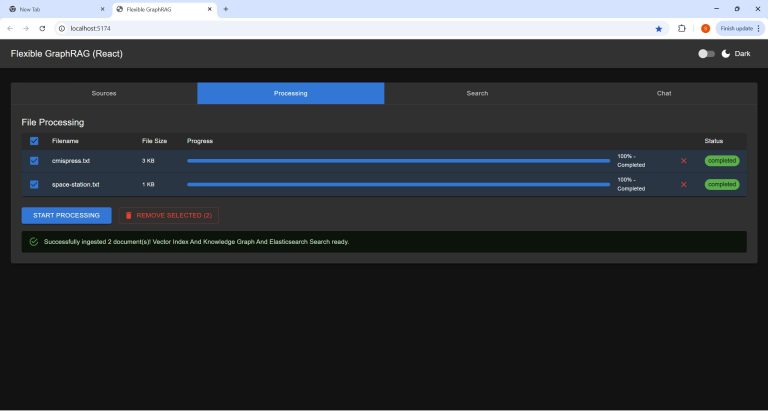
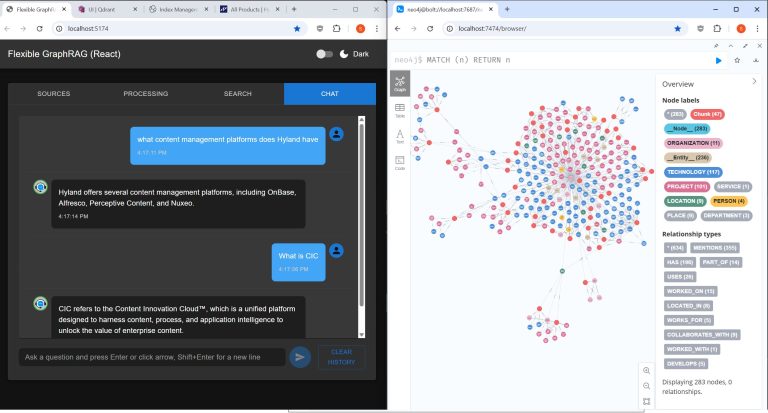
Sources tab: choose from the data sources (web, cloud storage, enterprise)Processing tab: documents ingested into the vector index, knowledge graph, and ElasticsearchAI chat answering from the auto-built knowledge graph, shown in Neo4j Browser
Flexible GraphRAG and RAG checkin: LlamaParse from LlamaIndex and Docling now both working for doc processing with Box, Google Drive, GCS, Azure Blob, S3, File Upload, Hyland Alfresco, and CMIS data sources. Please 🌟 Star the GitHub repo https://github.com/stevereiner/flexible-graphrag
1. LlamaParse added as an additional configurable doc processing choice beyond Docling (default). 2. Newly working Box, Google Drive, GCS, Azure Blob Storage data sources work with both Docling and LlamaParse. 3. Previous data sources that worked with Docling now also working with LlamaParse: File Upload, Hyland Alfresco, CMIS, S3 4. Currently working to get SharePoint and OneDrive for Business to test. 5. The web data sources (Web Pages, Wikipedia, YouTube) don’t use document processing
Flexible GraphRAG or Flexible RAG, an Apache 2.0 open source python platform, uses LlamaIndex, supports 8 graph databases, 10 vector databases, 3 search engines, and 13 data sources, Also supports knowledge graph auto-building, schemas, LlamaIndex LLMs, Docling and LlamaParse doc processing, GraphRAG mode, RAG only mode, Hybrid search, and AI query / chat. Has React, Vue, and Angular frontends, and a FastAPI backend. React, Vue, Angular, Backend work on Windows, Mac, Linux (standalone or in docker). Also has a FastMCP MCP server. Has a convenient docker compose that can include any of the databases (Vector, Graph, Search, Alfresco) and Dashboards / Consoles.
Flexible GraphRAGor Flexible RAG, an Apache 2.0 open source python platform, is now flexing to the max using LlamaIndex, in terms of supporting more databases and data sources: supports 8 graph databases, 10 vector databases, 3 search engines, and 13 data sources,. Also supports knowledge graph auto-building, schemas, LlamaIndex LLMs, Docling doc processing (LlamaParsecoming soon), GraphRAG mode, RAG only mode, Hybrid search, and AI query / chat. Has React, Vue, and Angular frontends, and a FastAPI backend. React, Vue, Angular, Backend now work on Windows, Mac, Linux (standalone or in docker). Also has a FastMCP MCP server.Has a convenient docker compose that can include any of the databases (Vector, Graph, Search, Alfresco) and Dashboards / Consoles.
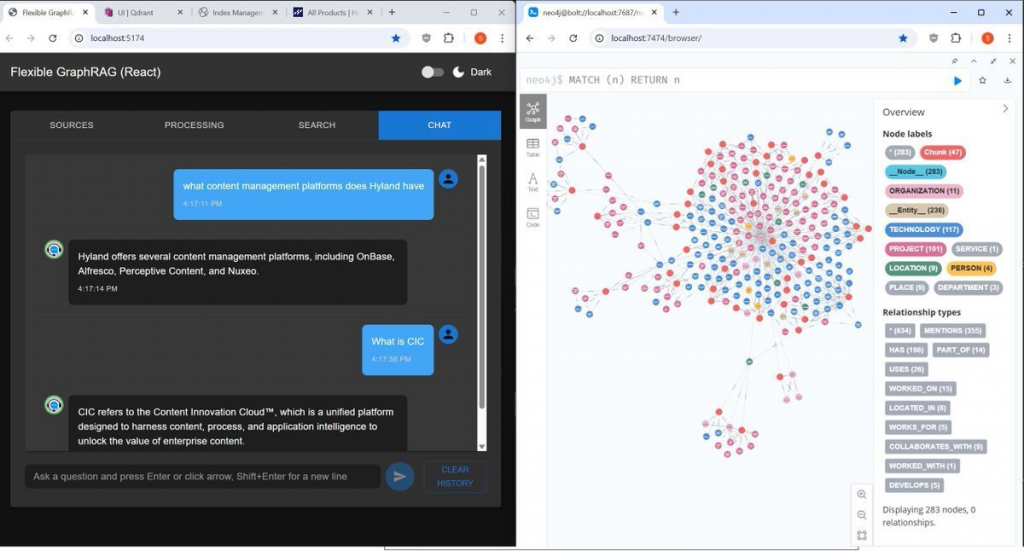
(Flexible GraphRAG AI chat shown with Hyland products web page(s) used with web pages data source to auto-generated a Neo4j graph).
Convenient docker compose: you can choose to include from all supported 10 vector and 8 graph databases, Elasticsearch, OpenSearch, and Hyland Alfresco Community. Include in the docker-compose.yaml by just removing the # comment in front of their includes. Dashboards / Consoles for these databases, as much as possible are also included in the docker compose choices (either in the yaml file for the database or for some a separate yaml file include).
You can run the docker with the databases with the backend and frontends (React, Angular, Vue) running stand alone in separate terminal windows. In addition to running the databases in docker, you can include the backend and frontends in the dock compose by including the app-stack.yaml and proxy.yaml includes. Now have no config duplication for standalone backend+frontends vs full docker mode: previously had to repeat all config in app-stack.yaml now use env_file: include standalone backend .env and overrides with include of docker.env (for configs that need host.docker.internal)
New Data Sources: using LlamaIndex readers: 1. working ones that don’t use document processing: Web Pages, Wikipedia, Youtube, 2. working using document processing: S3, 3. ones using document processing still to test: Google Drive, Microsoft OneDrive, Azure Blob, GCS, Box, SharePoint.
Support for Docling document processing is currently available. Being able configure to use LlamaParse coming soon.
Original data sources with document processing that don’t use LlamaIndex readers: filesystem, Alfresco, CMIS. Hyland Alfresco Community can be included in the docker compose by taking the “#” comment off the beginning of its include.
LLMs: LlamaIndex LLMs (LlamaIndex has support for very many), Flexible GraphRAG currently has config for 1. tested, working: OpenAI, Ollama, 2. untested: Anthropic Claude, Google Gemini, Azure OpenAI.
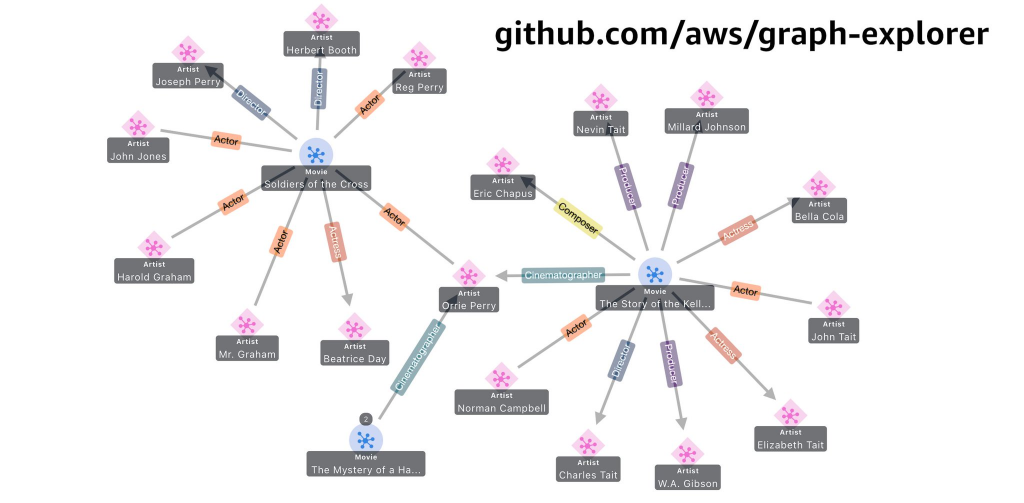
Graph Explorer is supported and working with these graph databases and is also checked in. It runs in a docker and can be used to query and visualize with both Amazon Neptune and Amazon Neptune Analytics.
Gremlin and openCypher can be used in Amazon Neptune with Graph Explorer, while openCypher is the primary language for Neptune Analytics. SPARQL is available for graph queries in the general Neptune database, SPARQL support for Graph Explorer is officially on the AWS development roadmap, but no firm timeline has been announced as of October 2025
Note that for Neptune Analytics, Flexible GraphRAG had to put in a wrapper class to filter out vector queries from its LamaIndex integration that were causing errors in Neptune Analytics. This wasn’t an issue with regular Neptune.
Flexible GraphRAGor Flexible RAG, an Apache 2.0 open source python platform, supports 8 graph databases, 10 vector databases, 3 search engines, and 13 data sources,. Supports knowledge graph auto-building, schemas, LlamaIndex LLMs, Docling doc processing (LlamaParse coming soon), GraphRAG mode, RAG only mode, Hybrid search, and AI query / chat. Has React, Vue, and Angular frontends, and a FastAPI backend. React, Vue, Angular, and Backend now work on Windows, Mac, Linux (standalone or in docker). Has a convenient docker compose that can include any of the databases (vector, graph, search, alfresco) and dashboards / consoles. There is also a Flexible GraphRAG MCP server.
ArcadeDB (Apache 2.0) is a next generation Multi-Model Database for Graphs, Documents, Key/Value and Time-Series. Supports SQL, Cypher, Gremlin and MongoDB queries
Flexible GraphRAG is open source python platform supporting Docling document processing, knowledge graph auto-building, schemas, 13 data sources, 10 Vector databases, 7 Graph databases, ElasticSearch and OpenSearch search engines, RAG, GraphRAG, hybrid search, and AI query / chat. Has React, Vue, and Angular frontends, and a FastAPI backend. Also has a FastMCP MCP server.
Added performance testing results to readme.md (6 docs with openai with each graph database (neo4j, kuzu, falkordb)
Added docs/performance.md: has performance testing results for each graph database with 2,4,6 docs with openai and 2,4 docs with ollama
Added support for FalkorDB graph database https://www.falkordb.com/ and https://github.com/FalkorDB/falkordb The abstractions of LlamaIndex, LlamaIndex support for FalkorDB, and the configurability of flexible-graphrag made this a relatively straightforward process.
Added LlamaIndex DynamicLLMPathExtractor support (works on openai, not on ollama currently)
Added config of kg extractor type (simple, schema, or dynamic) to set which LlamaIndex extractor to use (SimpleLLMPathExtractor, SchemaLLMPathExtractor, or DynamicLLMPathExtractor)
Added config of MAX_TRIPLETS_PER_CHUNK and MAX_PATHS_PER_CHUNK
Added readme.md info on system environment setup of ollama for performance and parallelism (OLLAMA_CONTEXT_LENGTH, OLLAMA_NUM_PARALLEL, etc.)
Added new default schema with 35+ relationship combinations, more relations, and entity types: PERSON, ORGANIZATION, TECHNOLOGY, PROJECT, LOCATION
Fixed file upload dialog performance in all 3 front ends: React, Angular, and Vue (chosen files display quickly after dialog ok)