X.com Steve Reiner @stevereiner LinkedIn Steve Reiner LinkedIn Posts
Repost of my LinkedIn post from May 15, 2026 (original LinkedIn post)
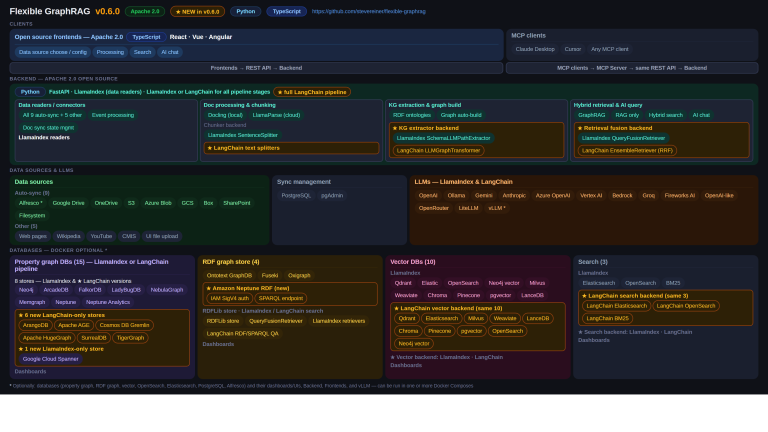
Flexible GraphRAG v0.6.0 released: Full LangChain support in addition to LlamaIndex, more DBs: 15 graph (8 + Arango, Apache AGE, Microsoft Azure Cosmos for Gremlin, SurrealDB, Google Cloud Spanner, HugeGraph, TigerGraph), 4 RDF (3 + Amazon Neptune RDF), 10 vector, 3 search.
GitHub repo: https://github.com/stevereiner/flexible-graphrag
Flexible GraphRAG is an Apache 2.0 open source AI context platform supporting a document processing pipeline (Docling or LlamaParse), knowledge graph auto-building, ontologies, schemas, many LLM providers, GraphRAG and RAG, hybrid semantic search (fulltext, vector, property graph, RDF/SPARQL), AI query, and AI chat. The backend is Python. Angular, React, and Vue TypeScript frontends and an MCP server are included. The stack supports 13 data sources (9 with incremental auto-sync), 15 property graph databases, 4 RDF triple stores , 10 vector databases, OpenSearch / Elasticsearch / BM25 search, and Alfresco.
Goals for added Flexibility with Frameworks and Pipelines:
1. More Databases
2.a. Framework Independence (with adapter layer)
2.b. support both LangChain and LlamaIndex python application / agent developers (will need python apis not just current REST and MCP).
3. Flexible pipelines: custom python for stages and pipelines
4. Support OpenRAG or OpenRAG like with customizable visual Langflow
flows for the pipeline and retrieval flows.
5. Support the CocoIndex rust pipeline and incremental engine as option to current flexible graphrag incremental update system (python/postgres). Also Flexible GraphRAG data sources and property graph, rdf, vector, search dbs could be used with CocoIndex as custom connectors (in addition native and other custom CocoIndex connectors). Flexible GraphRAG’s React, Vue, and Angular frontends would provide UI.
What's new:
• Full LlamaIndex, LangChain or mixed pipeline: chunker, KG extractor, graph/vector/search backends, retrieval fusion — each independently configurable
• 15 property graph DBs (8 LI stores + 8 LangChain matching versions + 6 LC-only + 1 new LI) All 15 can be used in a LlamaIndex or LangChain focused pipeline
• 4 RDF stores — now includes Amazon Neptune RDF
• 10 LangChain vector backends + 3 LangChain search backends duplicate LlamaIndex support
• LangChain EnsembleRetriever (RRF) + text-to Cypher / GQL / SurrealQL / AQL / SPARQL graph QA
• Docling OCR support (RapidOCR, EasyOCR, Tesseract, and more)
• Incremental add/delete/modify across all graph, vector, search, and RDF backends (for both LlamaIndex and LangChain backend stores)
• Integration testing: run_matrix and run_overnight can test all databases, LI / LC pipeline stages, all LLM providers, and all embedding providers
Update, v0.6.1 (May 16, 2026): Updated to v0.6.1 to fix packaging missing adapter files. The issue happened when installing from PyPI, not when using a GitHub source clone. The latest on PyPI is now 0.6.1 for both the main backend: https://pypi.org/project/flexible-graphrag/ and the MCP server: https://pypi.org/project/flexible-graphrag-mcp/